
Focal Impaired Consciousness Seizures (Complex Partial Seizures)
Learn More:
Donate to Support Our MissionWhat Is A Focal Impaired Consciousness Seizure?
A focal seizure begins in one side of the brain. Focal seizures are the most common type of seizures in adults with epilepsy.
When the seizure begins in one side of the brain and the person is not responsive or has confusion or a change in their level of awareness during some or all of the seizure, it is called a focal impaired consciousness seizure. This type of seizure was previously called a complex partial seizure or focal impaired awareness seizure. Awareness is assessed by whether the person can recall events during the seizure, and responsiveness is assessed by whether the person can follow a command
Learn about focal preserved consciousness seizures (previously simple partial seizures or focal aware seizures).
Where Do Focal Impaired Consciousness Seizures (Complex Partial Seizures) Usually Start?
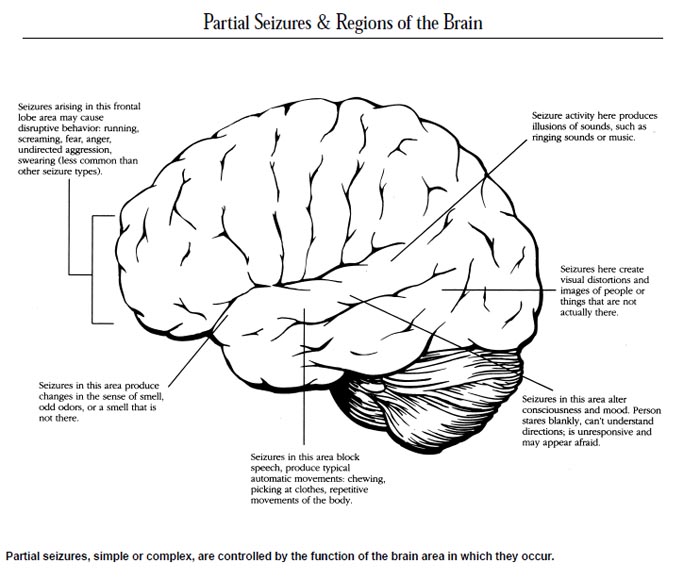
- These seizures usually start in one area or group of brain cells on just one side of the brain, most often in the temporal lobe or frontal lobe of the brain. They can also start in other areas too.
- Seizures that start in the frontal lobe tend to be shorter than the ones that start in the temporal lobe.
- Focal impaired consciousness seizures can include involuntary movements called automatisms (aw-TOM-ah-TIZ-ums) like rubbing the hands, picking at clothing, lip-smacking, and chewing movements. When seizures involve the frontal lobes, you may see bicycling of the legs, pelvic thrusting, or other complex movements.
- Some focal impaired consciousness seizures (usually ones beginning in the temporal lobe) start while the person is aware and responsive (this is commonly called an aura) but then the seizure progresses and impairs awareness and responsiveness either partially or completely.
- In this case, the focal seizure quickly spreads to involve other areas of the brain that affect alertness and awareness.
- The person loses awareness and stares blankly. They may have eyes open and may make movements that seem to have a purpose, but are not fully aware or not able to respond to a question or command. Some seizures make the person unable to move yet still partially aware of what is happening around them, since awareness may be only partially impaired, rather than entirely absent. Any decrease in awareness of the self or environment at any time during a seizure makes it a focal impaired consciousness seizure.
- If the symptoms are subtle, other people may think the person is just daydreaming.
- After a focal impaired consciousness seizure, the person may be tired or confused for about 15 minutes and may not return to normal function for hours.
- Some focal impaired consciousness seizures can spread to both sides of the brain. Previously called secondarily generalized seizures, the new name for this is focal to bilateral tonic-clonic seizures.
- Focal to bilateral tonic-clonic seizures usually last between 30 seconds and 3 minutes, but can sometimes be prolonged. If the seizure lasts longer than 5 minutes, or two or more seizures in a row happen without a full recovery in between, emergency medical help is needed.
What Does A Typical Seizure Look Like?
Here’s a typical story of someone having a focal impaired consciousness (complex partial) seizure:
"Susan's seizures usually occur while she's asleep. She makes a grunting sound, as if she's clearing her throat. Then she'll sit up in bed, open her eyes, and stare. She may clasp her hands together. If I ask her what she's doing, she doesn't answer. After a minute or so, she lies down and goes back to sleep."
- Some people can have seizures of this kind without realizing anything has happened.
- The seizure may make it difficult to retrieve memories of events just before or after it happened.
- Most people move their mouth, pick at the air or their clothing, or perform other involuntary purposeless actions (automatisms). Occasionally, people just freeze up and stare.
- Less often, people may repeat words or phrases, laugh, scream, or cry.
- Some people do things during these seizures that can be dangerous or embarrassing, such as walking into traffic or taking their clothes off.
- Everyone living with seizures should plan ahead and take safety precautions.
Who Is At Risk For Focal Impaired Consciousness Seizures?
Anybody can get them. They may be more likely in people who have had a head injury, brain infection, stroke, or brain tumor. There are also genetic conditions or developmental abnormalities in brain structure that can cause focal impaired consciousness seizures. Often though, the cause is unknown.
How Can I Tell If Someone Is Having A Focal Impaired Consciousness Seizure?
Focal impaired consciousness (complex partial) seizures sometimes resemble either daydreaming or (absence) seizures. Review the following questions to learn some of the differences. Download a table with these questions and talk to your health care provider about your seizures.
How frequent are the episodes?
- Focal impaired consciousness seizure: Rarely more than several times per day or week
- Absence seizure: Often seen multiple times per day
In what situations do they occur?
- Daydreaming: Boring situation
- Seizure: Any time, including during physical activity
Do they begin abruptly?
- Daydreaming: No
- Seizure: Usually yes. Some focal impaired consciousness seizures begin slowly with a warning, like an aura.
Can they be interrupted?
- Daydreaming: Yes
- Seizure: Usually not
How long do they last?
- Daydreaming: Until something interesting happens
- Focal impaired consciousness seizure: Up to several minutes
- Absence seizure: A single seizure is rarely more than 15-20 seconds
Does the person do anything during the episode?
- Daydreaming: Probably just stares
- Focal impaired awareness seizure: Automatisms (involuntary movements) are common
- Absence seizure: Usually just stares but twitching of the eyelids or minor mouth movements could be seen.
What is the person like immediately after the episode?
- Daydreaming: Alert
- Focal impaired consciousness seizure: Often confused and/or tired
- Absence seizure: Alert immediately after the seizure ends
What Happens After A Focal Impaired Consciousness Seizure?
- When a focal impaired consciousness seizure ends, the person may be tired or confused for a while. It could be just 5-15 minutes or take longer for a person to feel back to their normal state.
- First aid should focus on keeping a person safe and comfortable. If a person has a rescue therapy to use, it may help prevent more seizures or help a person recover after it.
Learn More:
Contact Our HelplineHow Are They Diagnosed?
- Careful observation is critical. What happens before, during, and after an event helps the health care team know if it could be a seizure.
- An electroencephalogram (EEG) is a test that can also help to make the diagnosis. Sometimes a routine EEG is normal and more detailed testing that records a person during a seizure is needed. A normal EEG between seizures does not rule out a diagnosis of epilepsy and the presence of seizures at other times.
- MRI (magnetic resonance imaging) or CT (computed tomography) scans are done to help look for possible causes of the seizures. If they are abnormal, they will be abnormal even between seizures.
How Are They Treated?
- There are several medications that can help prevent focal impaired consciousness seizures.
- Other treatment options available at comprehensive epilepsy centers that should be considered if medicine is not controlling the seizures include:
What Should I Do If I Think My Loved One Or Myself May Have Focal Impaired Consciousness Seizures?
If you think you or a loved one may be having focal impaired consciousness seizures, let your doctor know your concerns right away and considering finding an epilepsy specialist. Untreated seizures can lead to injury, significant memory impairment, and in rare cases physical injury or death. Learn more about staying safe.
Learn More
First Aid ResourcesWhat Is The Outlook For People With Focal Impaired Consciousness Seizures?
- As for many other kinds of seizures, the outlook depends on the cause if known, where the seizures start, and what kind of treatment may be best.
- They may be outgrown or controlled with medication. This is more likely in children if no cause is found.
- If medications don’t control these seizures, surgery may be possible for some people. Surgery offers the chance to completely control seizures in some people.
- Dietary therapies also may reduce seizures in some people if medicines have been unsuccessful.
- Devices are options as well. Neuromodulation devices can help lower the number and intensity of seizures in many who try these.
If seizures are not completely controlled, seek a consultation from a neurologist that specializes in epilepsy (called an epileptologist). An evaluation at a comprehensive epilepsy center can help evaluate all treatment options.
Resources
Epilepsy Centers
Epilepsy centers provide you with a team of specialists to help you diagnose your epilepsy and explore treatment options.
Epilepsy Medication
Find in-depth information on anti-seizure medications so you know what to ask your doctor.
Epilepsy and Seizures Helpline
Call our Epilepsy and Seizures Helpline and talk with an epilepsy information specialist or submit a question online.
Tools & Resources
Get information, tips, and more to help you manage your epilepsy.
Related Stories


People & Community
Finding the Right School Fit for Your Child with Epilepsy & Special Needs
Read Story
